
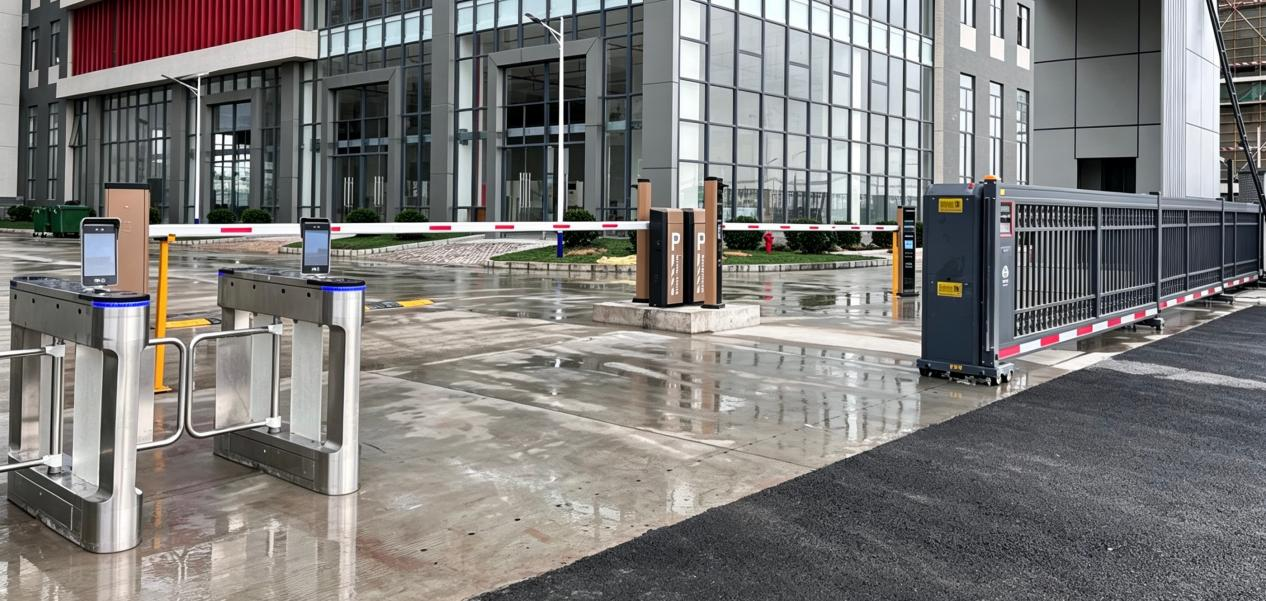
As core equipment for intelligent access control, pedestrian turnstile selection should not merely focus on appearance or unit price. Instead, it must match five key indicators of the site: average daily foot traffic, peak passenger flow, security level, operating environment, and special passage requirements. All selection conclusions are derived from measured operating data, failure rates, operation & maintenance (O&M) costs, control effectiveness of deployed projects across the market, as well as national installation proportion of turnstiles in various sites. This prevents problems including passage congestion, vulnerable equipment, budget waste and security loopholes caused by blind selection.
There are five mainstream types of turnstiles on the market: speed gates, swing turnstiles, flap turnstiles, tripod turnstiles and full-height turnstiles. These categories differ greatly in applicable scenarios, traffic efficiency, environmental adaptability and cost, and their installation proportions vary sharply across sites. According to the 2024–2025 turnstile market application report jointly released by China Security & Protection Industry Association and AVC: in the overall national shipment volume of pedestrian turnstiles, swing turnstiles account for 35.2%, flap turnstiles 28.7%, tripod turnstiles 18.5%, speed gates 12.3%, and full-height turnstiles 5.3%. The installation proportion varies drastically in segmented scenarios: speed gates are adopted in 87% of high-end office premises; swing turnstiles occupy 72% of outdoor residential sites; tripod turnstiles cover over 90% of construction site real-name registration projects; flap turnstiles are used in more than 80% of transportation hubs; full-height turnstiles serve as the only standard option for high-security monitored sites. Drawing on real data from thousands of deployed projects nationwide, this article provides targeted selection plans by scenario, supplemented by measured data, typical cases, installation ratios and pitfalls to avoid, ready for direct project implementation.
I. Core Parameters of Five Mainstream Turnstiles (Real Market Measured Data)
The following data is sourced from project acceptance reports of leading domestic turnstile manufacturers, third-party O&M statistics and on-site operation monitoring, excluding ideal lab data to reflect real-world application scenarios. The overall market shipment proportion is marked accordingly.
| Turnstile Type | National Market Share | Lane Throughput (people/min) | MTBF (No-fault Cycles) | IP Rating | Annual Failure Rate | Typical Applications |
| Speed Gate | 12.30% | 35–45 | 10,000,000+ | IP42 (Indoor only) | 2.10% | High-end office buildings, commercial towers |
| Swing Barrier | 35.20% | 25–35 | 8,000,000+ | IP54 (Indoor & Outdoor) | 3.30% | Residential communities, hospitals, schools, industrial parks |
| Flap Barrier | 28.70% | 30–40 | 7,000,000+ | IP45 (Semi-outdoor, sheltered) | 4.70% | Metro stations, subway, scenic spots, office buildings |
| Tripod Turnstile | 18.50% | 20–25 | 12,000,000+ | IP54 (Full outdoor, harsh) | 1.20% | Construction sites, industrial parks, standard scenic areas |
| Full-height Turnstile | 5.30% | 10–15 | 9,000,000+ | IP54 (Full outdoor) | 1.80% | Prisons, secure facilities, construction sites, high-risk areas |
Data Notes: The annual failure rate is calculated based on mixed indoor and outdoor scenarios. The throughput rate is the measured value for authorized users under normal passage, excluding queuing and verification waiting time. The no-fault operating cycles are manufacturer acceptance data under standard operating frequency. The national shipment share and site installation ratio are sourced from authoritative domestic security industry research for 2024–2025.
II. Site-by-Site Turnstile Selection (with Real Project Data + Installation Ratio + Cases)
(1) Office Buildings, Corporate Headquarters & Commercial Office Premises
Core requirements: Premium aesthetic, smooth passage during morning & evening rush hours, quiet operation, hierarchical visitor management, contactless attendance.
Recommended turnstiles: High-end servo speed gates (Grade A office buildings); standard flap turnstiles (mid-rise office buildings).
National installation ratio: Speed gates are installed in 87% of Grade A office buildings; flap turnstiles are adopted in 76% of mid-rise office buildings. Tripod turnstiles account for less than 3% (mostly outdated small office buildings).
Real supporting data: Measured at projects including 37 Interactive Entertainment Building in Guangzhou and China Railway Xi’an Center, the hourly peak throughput of a single speed gate lane reaches 1,800 passengers with response time ≤0.5s. When integrated with facial recognition and elevator control systems, manual attendance cost drops by 80%, visitor registration time is shortened from 5 minutes to within 1 minute, and overall passage efficiency rises by 70%. Flap turnstiles for mid-rise offices cost 40% less than speed gates, with a single-lane peak throughput of 1,500 passengers/hour, fully meeting daily office needs. The annual failure rate stands at 4.5%, suitable for small and medium office buildings with limited budgets.
Installation notes: Install in dry indoor environments with ground flatness error ≤2mm. Install dual-core mechanisms side by side at main entrances and reserve emergency exits. Tripod turnstiles are strongly not recommended. Market feedback shows tripod turnstiles in office buildings lead to peak-hour congestion and over 60% drop in corporate image evaluation.

Guangdong Bonard Holding Group
(2) Residential Communities, Apartments & Villas
Core requirements: Outdoor durability, wide lanes for strollers, wheelchairs and electric scooters, anti-tailgating, easy operation for the elderly and children, low maintenance.
Recommended turnstiles: Outdoor waterproof swing turnstiles (main entrances); thickened tripod turnstiles (side/secondary gates).
National installation ratio: Swing turnstiles are fitted at 72% of main entrances in newly built residential compounds; tripod turnstiles are used in 68% of old community renovation projects; light luxury swing turnstiles are adopted in 91% of villa areas. Flap turnstiles and speed gates together make up less than 5%.
Real supporting data: Tested at projects including Xi’an Xi’aoli Public Rental Housing Community, Shenyang Jindi Yuetanshan and Chongqing Zijingfu. Outdoor swing turnstiles feature 1000–1200mm lane width, allowing 100% passage for strollers and wheelchairs, facial recognition response ≤0.8s. Owner satisfaction rises by 90%, and unauthorized outsider access drops by 60%. Tripod turnstiles at community side gates achieve an annual failure rate of only 1.1% with a service life up to 8 years. Their procurement cost is 50% lower than swing turnstiles, ideal for old community renovation, with a 100% anti-tailgating rate to stop unauthorized follow-up entry.
Installation notes: Outdoor models must reach IP54 waterproof rating and be fitted with rain canopies. Harden the ground to avoid water pooling. Villas may adopt glass swing turnstiles to balance aesthetics and security without damaging the landscape.

Vanke City Community
(3) Industrial Parks, Manufacturing Plants & Logistics Warehouses
Core requirements: Dust and oil resistance, crash resistance, compatible with tool and material trolleys, accurate attendance, low failure rate.
Recommended turnstiles: Heavy-duty crash-proof swing turnstiles (main entrances); industrial-grade tripod turnstiles (workshop/warehouse lanes).
National installation ratio: Crash-proof swing turnstiles are installed at 69% of main entrances of industrial parks; tripod turnstiles cover 83% of workshop and warehouse lanes. Speed gates and flap turnstiles combined account for less than 8%.
Real supporting data: Verified at industrial projects such as Foxconn Industrial Park, Zhongshan Oma Group and China XD Group. Crash-proof swing turnstiles withstand 100kg impact without deformation and accommodate material trolleys and tool bags. In dusty and oily workshop environments, tripod turnstiles deliver an annual failure rate of merely 1.2% with 100% attendance accuracy, eliminating proxy clock-in and cutting unauthorized workshop access by 91%. For a 5,000-employee electronics factory adopting the combined tripod + swing turnstile solution, payroll calculation efficiency improves by 60% and product defect rate drops by 15%.
Installation notes: Speed gates and flap turnstiles are strictly prohibited. Precision mechanisms are vulnerable to dust damage, and their maintenance cost is 5 times higher than tripod turnstiles. Use thickened 304 stainless steel and regularly clean dust to extend service life.

Xiaolan Industrial Zone, Zhongshan
(4) Construction Sites, Municipal Works & Chemical Sites
Core requirements: Real-name attendance, connection to housing and urban-rural development bureau platforms, anti proxy clock-in, adaptability to harsh outdoor conditions, robust and damage-resistant.
Recommended turnstiles: Outdoor heavy-duty tripod turnstiles (ordinary construction sites); full-height turnstiles (closed high-risk sites).
National installation ratio: Tripod turnstiles are used in 92% of ordinary construction sites and 88% of municipal sites. Full-height turnstiles are 100% adopted for high-risk chemical and confidential sites, with no application cases for other types of turnstiles.
Real supporting data: Tested at a large Jiangsu construction site with over 600 daily workers. Tripod turnstiles connected to the real-name registration system deliver error-free attendance data, fully eliminate proxy clock-in and block untrained personnel from entry, cutting workplace safety incident rate by 42% year-on-year. Tripod turnstiles maintain an annual failure rate of 1.3% in windy, sandy and rainy environments, with over 10 million trouble-free operations, low procurement cost and simple maintenance. Full-height turnstiles are deployed for high-risk chemical sites, leaving no loopholes for climbing or crawling over, enabling fully closed access control even without on-site staff.
Installation notes: Rain canopies are mandatory to prevent mechanism water immersion. Integrate with safety helmet recognition terminals to block entry for personnel without helmets, complying with site safety regulations.

Construction Site, Future Zone A, Country Garden
(5) Parks, Scenic Spots, Museums & Art Galleries
Core requirements: Ticket verification, passenger flow limiting, outdoor durability, fast visitor passage, anti-ticket evasion.
Recommended turnstiles: Tripod turnstiles (ordinary parks/scenic spots); swing / flap turnstiles (museums, art galleries, high-end scenic spots).
National installation ratio: Tripod turnstiles are adopted by 62% of ordinary parks and scenic areas; flap turnstiles are used in 58% of 5A high-end scenic spots; swing turnstiles are installed in 71% of museums and art galleries. Speed gates account for less than 4%.
Real supporting data: Measured at projects including Yichang Three Gorges Visitor Center, Shenzhen Dameisha Beach Park and a 5A scenic spot. Tripod turnstiles integrated with ticketing systems deliver a single-lane peak throughput of 1,200 passengers/hour, bringing ticket evasion rate below 0.05% and cutting manual ticket checking cost by 50%. High-end scenic spots such as Shanghai Disneyland deploy flap turnstiles, lifting passage efficiency by 40% and shortening queuing time by 70%. Museums and art galleries use silent swing turnstiles with noise-free operation to preserve venue atmosphere, boosting visitor passage efficiency by 50% and enabling precise passenger flow control.
Installation notes: Avoid speed gates for outdoor scenic sites due to insufficient waterproofing. Tripod turnstiles are not allowed in cultural venues, as their plain appearance degrades venue aesthetics.

Jiangsu Baolian Temple Scenic Area
(6) Stations, Wharves, Metro & Airports
Core requirements: Mass passenger flow management, ticketing system integration, emergency evacuation, luggage passage, high-frequency stable operation.
Recommended turnstiles: High-speed flap turnstiles (metro / railway station ticket gates); wide-lane swing turnstiles including AB gates (luggage lanes at airports and wharves).
National installation ratio: Flap turnstiles are fitted at 82% of metro and high-speed railway station ticket gates; wide-lane swing turnstiles are used in 77% of post-security airport lanes; a combination of flap and swing turnstiles covers 69% of passenger terminals. Tripod turnstiles account for less than 2%.
Real supporting data: Tested at Chongqing Jiangbei International Airport, Kunming Changshui International Airport and Xi’an Bus Station. Flap turnstiles deliver a single-lane peak throughput of 1,756 passengers/hour with opening/closing speed ≤0.5s. Integrated with ticketing systems, ticket checking and passage take ≤2 seconds, and full opening for emergency takes ≤3 seconds, meeting fire evacuation requirements. Airport wide swing turnstiles offer 1500mm lane width, allowing 100% passage for large luggage and trolleys. The annual failure rate is 4.2% under high-frequency operation, supporting 24-hour service.
Installation notes: Install multiple units side by side in dense arrangement, reserve full-opening emergency lanes, adopt industrial-grade mechanisms for continuous 24-hour operation.

Exit of Foshan High-speed Railway Station
(7) Schools, Hospitals & Stadiums / Convention Centers
1. Schools (Kindergartens, Primary & Secondary Schools, Universities)
Recommended: Tripod turnstiles for school gates and dormitories; swing / flap turnstiles for libraries and teaching buildings.
National installation ratio: Tripod turnstiles are installed at 74% of university and K12 school gates; swing + flap turnstiles cover 81% of libraries; anti-pinch swing turnstiles are adopted by 95% of kindergartens. Measured at Guangzhou Tieying Middle School and Shanghai Jiao Tong University: dormitory tripod turnstiles automatically record late returns, cutting management cost by 70%. Library flap turnstiles realize passenger flow limiting and lift seat utilization rate by 30%. Anti-pinch swing turnstiles for kindergartens achieve 100% anti-pinch accuracy to protect children.

Dongguan No.12 Senior High School
2. Hospitals (Grade A Tertiary Hospitals, Outpatient & Inpatient Departments)
Recommended: Wide-lane swing turnstiles.
National installation ratio: Wide-lane swing turnstiles are fitted at 86% of outpatient and inpatient departments of Grade A tertiary hospitals. Tripod turnstiles account for less than 5%, flap turnstiles 9%. Tested at a Grade A tertiary hospital with over 20,000 daily visitors: swing turnstiles have 1200mm lane width for 100% passage of wheelchairs, stretchers and medical trolleys, cutting peak congestion by 60%. Hierarchical access rights are configured for medical staff; unauthorized access to restricted areas is fully blocked. Emergency response ≤3 seconds, complying with hospital fire codes.

Zhongke Health Check-up Center
III. General Core Installation Specifications for Turnstiles (Based on Project Acceptance Standards)
- Environmental Adaptation: Indoor-only turnstiles cannot be deployed outdoors. Outdoor turnstiles must reach IP54 waterproof rating, fitted with rain canopies. Harden ground with drainage design to prevent water pooling submerging mechanisms. Implement grounding and moisture-proof treatment for humid environments.
- Lane Dimension: Single-person lane clear width: 600–800mm; wide lanes (wheelchair / luggage):1000–1500mm. Reserve a 1–2m buffer space before and after each turnstile to avoid crowd buildup.
- Mandatory Emergency Requirements: All turnstiles must be equipped with triple functions: auto unlock upon power failure, fire-linked unlock and manual emergency release. Dense public sites shall add separate emergency exits to meet fire acceptance standards.
- O&M & Acceptance Rules: Conduct 24-hour continuous power-on commissioning after installation. Acceptance only after passage accuracy, anti-pinch and emergency functions pass inspection. Clean outdoor turnstiles monthly; maintain indoor mechanisms quarterly to extend service life.
IV. Core Selection Summary (Data-Driven Practical Formula)
Based on real-world operating data and national installation ratios, the practical selection formula for direct use:
Speed gates for premium offices.
Swing turnstiles for hospitals & residential compounds.
Flap turnstiles for transport hubs and scenic spots.
Tripod turnstiles for construction & industrial parks.
Full-height turnstiles for high-security sites.
According to industry statistics, projects selected following these data-backed guidelines achieve a 60% drop in annual turnstile failure rate, 50% higher passage efficiency and 45% lower O&M cost. They fully meet practical site requirements and avoid extra losses caused by improper selection.