
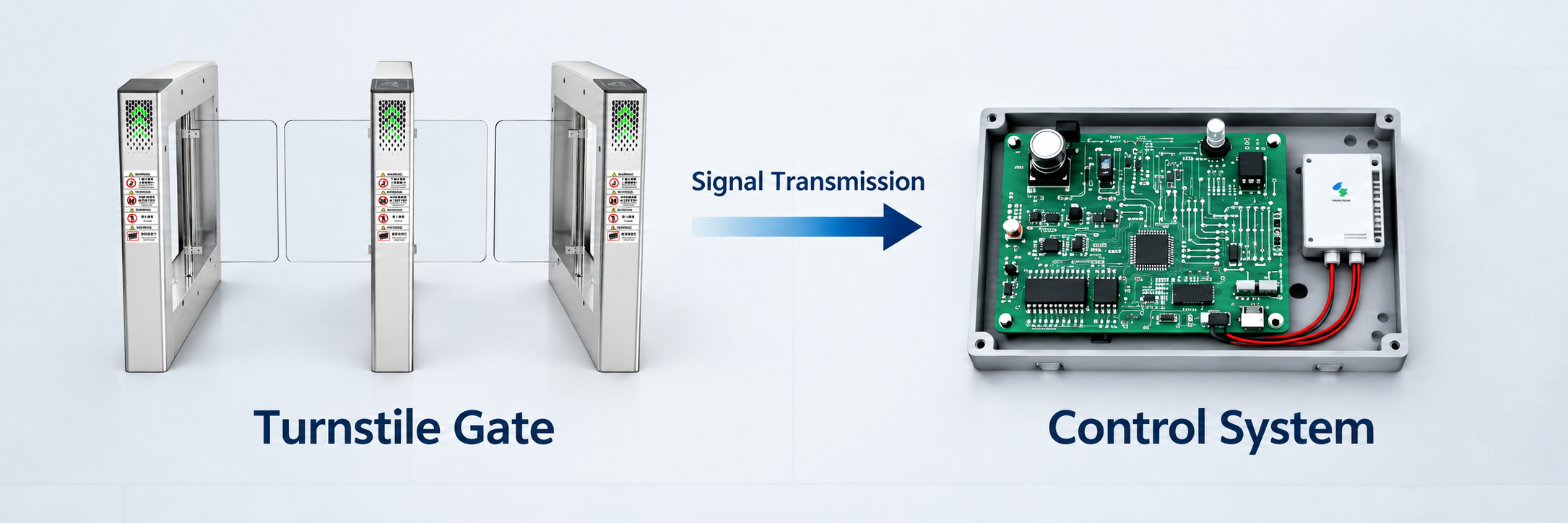
When purchasing pedestrian turnstiles, many customers first focus on appearance, material, or recognition methods (card swiping, facial recognition, QR codes). However, during real project operation, the underlying factor that truly determines whether the equipment is stable, durable and delivers a good user experience is the motor and its control system — the “core drive system” of the turnstile.

From an engineering and application perspective, this article combines practical parameters and project experience to help you fully understand the differences between various motor solutions and how to select the right one for your project.
1. Why does the motor determine turnstile stability?
Statistics based on operation and maintenance data from multiple pedestrian turnstile projects show:
- Around 60%~70% of turnstile failures occur in the motion system
- Among these, motor and drive-related issues account for more than 50%
This means the motor system directly determines the service life, stability and passage experience of a turnstile.
We often encounter this situation in field projects:
- The equipment runs normally at the initial stage
- Stuttering, abnormal noise and frequent faults start to appear after 1~2 years of use Most of these problems can be traced back to the motor type and control method.
2. Core Data Comparison of Different Motor Solutions
Currently, pedestrian turnstiles on the market mainly adopt three motor options: brushed motors, brushless DC motors (BLDC) and servo motors. Below is a comparison of typical engineering parameters (general industry ranges).
| Index | Brushed Motor | BLDC Brushless Motor | Servo Motor |
| Service Life | ≥3 million cycles | ≥5 million cycles | ≥10 million cycles |
| Daily Passage Load | 20,000 ~ 40,000 cycles | 20,000 ~ 40,000 cycles | ≥50,000 cycles |
| Single Gate Opening Time | Max 0.6s | Max 0.6s | Max 0.3s |
| Noise Level | 65~75 dB | 65~75 dB | ≤60 dB |
| Control Accuracy | Low | Medium | High |
| Maintenance Interval | 3~6 months | 3~6 months | 6~12 months |

During project selection, we usually match motor solutions based on traffic frequency and service life requirements, rather than simply comparing equipment prices. Compared with traditional brushed motors, brushless motors have a service life 2 to 3 times longer. Servo motors further improve performance in speed, precision and safety.
3. Differences in Passage Efficiency: Quantifiable Experience Improvement
Many customers say they want “smoother” turnstile operation, and smoothness can actually be quantified.
3.1 Opening speed (directly affects queuing)
- Brushed motor: approx. 0.6s
- Brushless motor: approx. 0.6s
- Servo motor: up to 0.3s
In office building and park projects with daily traffic of over 20,000 people, obvious differences can be observed:
- Brushed motor: approx. 25~35 people per minute
- Brushless motor: approx. 25~35 people per minute
- Servo motor: more than 35 people per minute
This gap directly translates to queuing and congestion issues.
3.2 Operation smoothness (whether the turnstile “stutters”)
The key lies in acceleration and deceleration control capability:
- Brushed motor: no control → abrupt start and stop
- Brushless motor: basic curve control → generally smooth
- Servo motor: S-curve control → almost no mechanical impact
In high-frequency traffic scenarios, this difference is continuously amplified and greatly affects overall passage experience.
3.3 Noise control (impact on the surrounding environment)
Commercial office environments generally require noise ≤50 dB.
- Brushed motor: above 60 dB (noticeable noise)
- Brushless motor: generally meets the requirement
- Servo motor: nearly silent
4. Safety Performance: Key Differences Brought by Motor Types
4.1 Anti-pinch response speed
- Brushed motor: 100~300 ms
- Brushless motor: 50~100 ms
- Servo motor: 10~50 ms
Shorter response time means higher safety, especially in crowded areas.
4.2 Torque control (anti-rush performance)
In projects where users may rush through or apply external force to the barrier:
- Brushed motor: unable to precisely control torque, easy to get damaged
- Brushless motor: basic adjustable torque
- Servo motor: dynamic torque control (error <5%)
4.3 Power-off protection
Turnstiles complying with engineering standards must support:
- Automatic barrier opening upon power failure
- Compliance with emergency evacuation requirements
5. Industry Standards: Important Reference for Project Selection
For engineering projects, pedestrian turnstiles need to meet relevant standards, such as:
- GA/T 1260-2026 Technical Specification for Electrically Controlled Pedestrian Passage Turnstiles
- GJB 899A-2009 Reliability Identification and Acceptance Test
For projects following these standards, motor solutions with higher stability are usually preferred for high-traffic scenarios.
6. How to Select Motor Solutions for Different Scenarios
Based on practical project experience, here is our recommendation:
- Construction sites / temporary projects
Requirement: cost priority
Recommended: brushed motor
- Factories / schools
Requirement: stable, durable and low maintenance
Recommended: brushless motor (service life over 5 million operations)
- Office buildings / commercial complexes
Requirement: efficiency & user experience
Recommended: brushless or servo motor
- Premium offices / financial institutions
Requirement: low noise, premium experience and high safety
Recommended: servo motor
When selecting equipment for projects, we comprehensively match the motor and control solution according to traffic frequency, service life and site requirements instead of making decisions based on a single parameter.
7. Summary: How to Avoid Pitfalls in Selection
If you only remember one takeaway from this article: The difference between turnstiles lies not in appearance, but in the motor and control system.
More specifically:
- Low-frequency scenarios: brushed motor is acceptable
- Regular projects: brushless motor is preferred
- High-end projects: servo motor is recommended
8. One-sentence conclusion
A poor motor choice leads to continuous maintenance costs in later operation; a well-selected motor turns your equipment into a long-term stable asset.
If you are working on project selection, focus on these points:
- Motor type (brushless or servo)
- Control method (with acceleration & deceleration control or not)
- Supported by real field operation data
For specific projects, tailor the motor and control solution to actual traffic demands. This is often more effective than simply comparing parameter sheets.